LIBERATED
From August 1944, the German army slowly but surely began to withdraw behind the West Wall. This border defense was extended through the Gelderse Vallei via Kleve, Arnhem and Wageningen. The Grebbe Line was included in this ‘Panthsterstellung’, as a result of which the west of the Netherlands was deprived of fuel, medicine and food. Until the May days of 1945, the line formed the border between the liberated and occupied Netherlands.
Top display plate
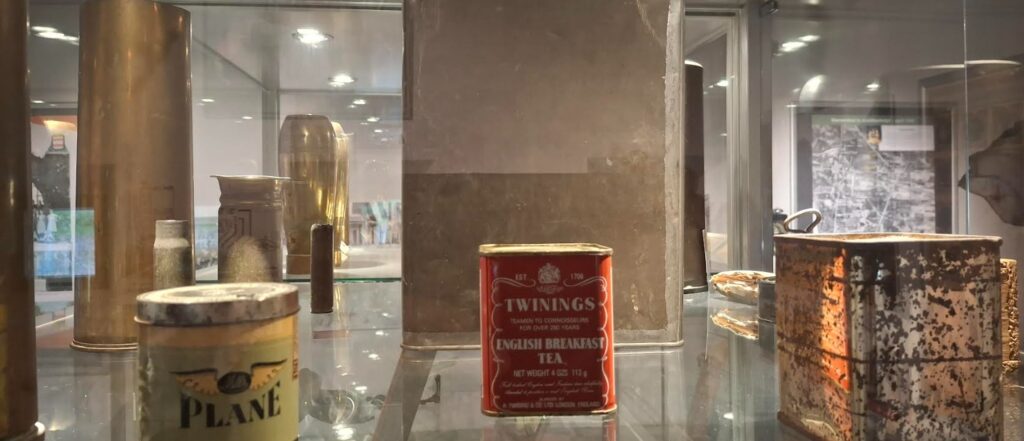
On the top plate are relief supplies that were distributed to the population by the Allies: tea, coffee, cigarettes, chocolate, biscuits and milk powder, often in cans.
Second display plate

On the second plate is a Mauser Carbine. This weapon was still produced after the Second World War. The example shown is a post-war model from Spain, La Coruna. The German M42 helmet belongs to the Ordnungspolizei, which carried out checks, collected Jews in hiding and carried out surveillance assignments. Backpack is a so-called M39 Tornister. German soldiers called it an ‘Affe’, because of the fur, which was used to keep the bag waterproof
Third display plate

On the third plate is a revolver of a Canadian tank commander and a scale model of a British carrier, with which the first reconnaissances were made in Renswoude (April 26, 1945). The steel Brodie (Mk 2) helmets were worn by British and Canadian troops. A radio is hidden in the grey box: owning a radio was prohibited from May 1943.
Bottom display plate

A scale model of the Hawker Typhoon is visible on the bottom plate. An aircraft of that type crashed near De Klomp on October 5, 1944. Canadian Pilot Wakeman was killed. The booklet claims that Germany should cede territory to the Netherlands as compensation for wartime suffering. This also happened on a limited scale, but in 1963 this area (Elten, Selfkant) was largely repurchased.